


FST-7 Chest Biomechanics: The Power of Converging in the Incline Dumbbell Press
The incline dumbbell press is one of the most fundamental and effective exercises for building muscle volume and thickness in the upper chest muscles (clavicular part of the pectoralis major). But once you move to heavy dumbbells, the biomechanical complexity increases drastically. Unlike a fixed machine or a barbell, dumbbells require an extreme degree of stabilization.
Hany Rambod, the 24-time Olympia-winning coach and the physiological force behind Evogen Nutrition, shares in this FST-7 guide a crucial biomechanical principle to protect your shoulders and maximize mechanical tension isolation on your chest muscles.
The Converging Movement Path: Move Inward
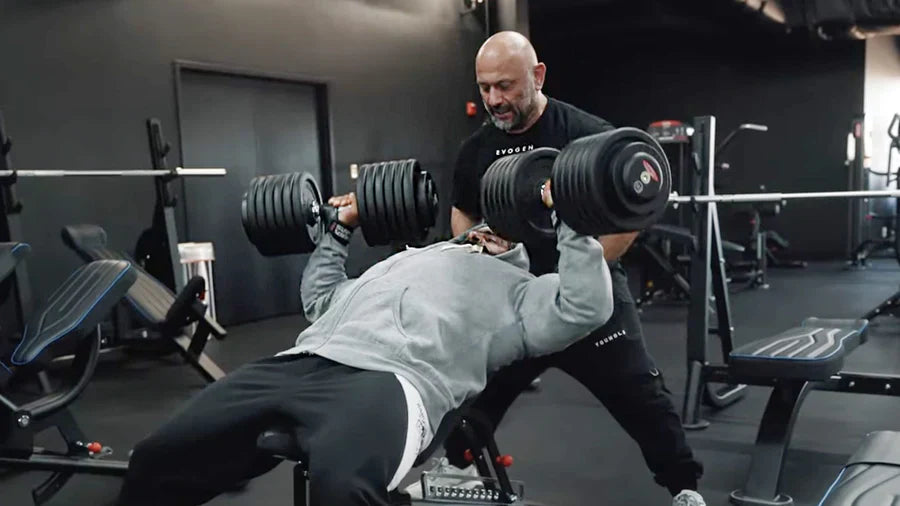
The absolute key to success when pressing heavy with dumbbells is the direction of the upward movement. Rambod emphasizes that you should always move the dumbbells slightly toward each other during the concentric (upward) phase — a physiological principle known as converging.
When you push the dumbbells up, they should come together at the top of the movement. This follows the natural, anatomical fiber direction of the chest muscle, which runs from the collarbone and sternum to the upper arm. By converging at the top, you achieve a physiologically maximal shortening and a deep contraction of the chest muscle that you simply miss with a straight barbell movement.
The Danger Zone: Outward Movement and Shoulder Injury
What happens when the weight becomes too heavy? Many athletes lose control over the movement path under heavy mechanical pressure, causing the dumbbells to drift slightly outward during the upward movement. Hany Rambod strictly warns against this: as soon as the dumbbells drift outward, you enter the physiological danger zone.
If the weights drift outward, you lose the mechanical leverage of your chest muscles. If you have to drop or 'dump' the dumbbells at that moment, a massive, uncontrolled rotational force is placed on the shoulder joint and the rotator cuff. This is the fastest path to acute tears and long-term shoulder injuries.
Therefore, follow the iron rule of The Pro Creator: if you feel you can no longer control the dumbbells moving together at the top, the weight is simply too heavy physiologically. Put your ego aside, lower the weight, and rebuild control.
The Perfect Rep: Controlled Stretching and Squeezing
To optimally stimulate the chest muscles for maximum hypertrophy, divide the movement into two physiological phases:
-
The Eccentric Phase (The Stretch): Lower the dumbbells in a controlled and slow manner. Bring them down deep enough to feel a slight, physiological stretch in the muscle fibers of the upper chest. Make sure not to overstretch the muscle at the expense of joint stability.
-
The Concentric Phase (The Contraction): Push powerfully from the stretch and immediately bring the weights together toward the center above your chest. Consciously squeeze the chest muscles at the top before starting the next repetition.
The Evogen Strategy for Raw Strength and Muscle Stability
Performing heavy incline dumbbell presses requires maximum neurological drive and perfect hydration of the stabilizing muscle groups. Hany Rambod uses the elite sports formulas from Evogen Nutrition to optimally support this physiological process:
-
Pre-Workout Neurological Activation: Heavy dumbbell presses require your central nervous system to be sharp to stabilize the dumbbells. Take Evogen EVP Xtreme/3D beforehand for laser focus and brute strength. Stack this with the liquid Evogen EVP AQ (liquid glycerol) to increase osmotic pressure and push fluid deep into the muscle cells. This not only creates an extreme 3D pump but also increases the internal pressure and physiological stability of the muscle bellies.
-
Intra-Workout Muscle Protection and Hydration: To prevent your stabilizing muscles (such as your triceps and shoulders) from fatiguing prematurely, drink Evogen Amino K.E.M. during your workout. This formula saturates your cells with all 9 essential amino acids (EAAs) to immediately inhibit muscle breakdown, combined with a premium electrolyte matrix and coconut water powder to prevent cramps in the shoulder girdle.
-
Acute Post-Workout Recovery: As soon as you put down the dumbbells after your last heavy set, protein synthesis must be activated immediately. Nourish your damaged chest muscle fibers after training with Evogen IsoJect. This ultra-pure, cold-filtered whey isolate breaks down amino acids lightning-fast thanks to the patented IGNITOR™ enzyme technology, ensuring virtually loss-free absorption and immediate anabolic recovery.
Related reading
- FST-7: How to effectively resolve muscle imbalances and asymmetry in the chest
- Posing tips from Hany Rambod: The physiology behind the perfect side chest pose
- L-Citrulline: The physiological key to maximum nitric oxide production and muscle pump
Discover our collections
Ready to take your chest training to a professional level and maximize your performance? Discover our targeted collections at nutritionmonsters.com and build your stack: