



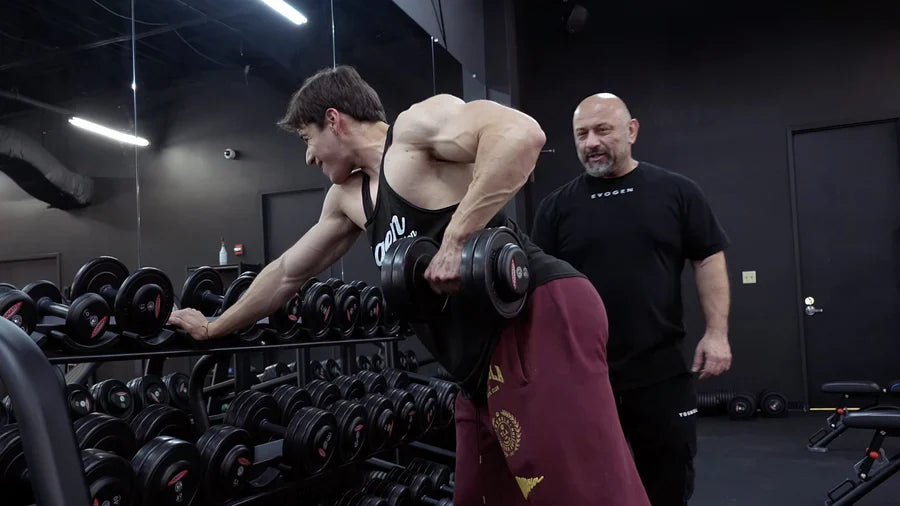
In this video, we see how the legendary 24-time Olympia-winning coach Hany Rambod perfects the biomechanics of the dumbbell row. Many athletes intuitively perform this fundamental exercise incorrectly by pulling the dumbbell straight up toward the chest or the top of the thigh. Rambod explains exactly why the movement path must be adjusted to maximally isolate the musculus latissimus dorsi (the broad back muscle).
The Correct Path: Pulling Toward the Obliques (Side Abdominal Muscles)
When performing the dumbbell row, the path of the weight determines which muscle group absorbs the most mechanical tension. Rambod corrects the athlete immediately during his first repetitions:
- The mistake: The athlete pulled the dumbbell almost straight up toward the top of his thigh/hip. This often causes the movement to be driven by the biceps and the rear deltoid instead of the back muscles.
- The FST-7 correction: Rambod forces the athlete to pull the dumbbell in a smooth, slightly arched motion backward, directly into the zone of the obliques (the side abdominal muscles). Although there are variations where you can pull slightly higher or lower, the approach toward the obliques is the physiological 'sweet spot' for maximum back activation.
The Pro Creator Tip: "Move slightly further back and pull the dumbbell directly into the oblique region. Only then will you really feel the back muscle working and train like an athlete."
The FST-7 Intensity Hacks: Stretch & Twist
To tear the back muscles three-dimensionally for maximum hypertrophy, Rambod adds two crucial biomechanical details at the end of the eccentric and concentric phases:
- The Extreme Stretch (At the Bottom): Let the dumbbell fully drop at the end of the downward phase and actively reach toward the ground to maximally stretch the latissimus dorsi at the bottom. This increases the Time Under Tension (TUT) in the most stretched position.
-
The Subtle Twist (At the Top): Once the dumbbell reaches the obliques, Rambod advises to slightly twist (rotate) the torso at the top and squeeze the shoulder blades together as much as possible. This creates an acute, maximal contraction of the entire lat wing.
The Foundation: Why Free Weights Are Superior to Machines
Although high-end machines (such as Panatta equipment) offer excellent biomechanics, Hany Rambod emphasizes that free weights (barbells and dumbbells) form the absolute foundation of any physique.
People often make the mistake of loading machines heavily right away without first establishing a foundation. Free weights force your body to engage stabilizing muscles. This not only builds a solid base in your back but also strengthens your forearms, biceps, and rear deltoids.
Once you have built this rigid foundation with dumbbells and barbells, you can then switch to machines to train extremely heavy. The built-up stability and strengthened tendon structures at that point ensure that you drastically reduce the risk of acute injuries during your heaviest work sets.
Related Reading
- FST-7 Chest Biomechanics: The Power of Converging in the Dumbbell Press
- Evogen Pre-Workout: The Physiological Guide for Beginners and Advanced Users
- The Biomechanics of Bench Pressing: A Guide to Raw Strength and Symmetry
Discover our collections
Ready to support your back training with the highest biochemical purity and maximize your recovery capacity? Discover the official elite sports collections at nutritionmonsters.com:

Leave a comment
This site is protected by hCaptcha and the hCaptcha Privacy Policy and Terms of Service apply.